


Emergency Management takes Centre Stage

Small communities need to stay engaged, experts say

Small communities need to work together to manage resources in case of emergencies, according to Emergency Management consultants Dave Mitchell and Associates.
Councillors attending last Tuesday's Committee of the Whole (COW) meeting heard an overview of the state of emergency management services in small communities from the consultants, who have been engaging small communities across the province over the past year.
Metro Vancouver's Division Manager of Protective Services & Emergency. Management Brant Arnold-Smith introduced the presentation by addressing the challenges that small communities face during emergency situations.
He said that despite the fact that each community is unique with different hazards and vulnerabilities, the ultimate goal of the exercise is to find a way to build resilient communities. Arnold-Smith was also supported at the event by Metro's Manager of Electoral Area and Environment Marcin Pachcinski.
Consultants David Mitchell and Ian McDonald discussed the meetings they had held with small communities (including Lions Bay) throughout British Columbia.
McDonald said the Emergency and Disaster and Management Act (EDMA) that was introduced in 2023 (and updated in May 2026) encouraged municipalities to coordinate with First Nations as well as neighbouring districts. He said that while these arrangements should be in writing that specifies areas of responsibility this system allows for the existence of multi-jurisdictional emergency management organizations.
A Public Works Mutual Aid agreement was endorsed across the province in 2022, but participation is voluntary for and it contains no process for triaging requests. Small communities have expressed concern that there is no breakdown of who to call for specific resources in case of emergency.
McDonald noted that Lions Bay, with a footprint of only 2.5 square miles and a population of 1,300, has had no formal risk or liability assessment in place. As was demonstrated during the Battani Creek landslide, this municipality has no capacity to handle a major event on its own. When the consultants met with Emergency Preparedness Coordinator Mary Brown and Chief Administrative Officer Ross Blackwell last November, they noted that the Village's Emergency Operations Centre is very small and not effective "beyond a level one activation."
He said that Brown and Blackwell both expressed the community's gratitude for the support of Metro Vancouver, the province and other local authorities during the Battani Creek disaster.
The consultants noted that emergency organization options for the Village include:
The development of sub-regional Arrangements, which would potentially be through North Shore Emergency Management, who are currently undergoing an administrative overhaul and may not be in a position to take on a new participant.
Seek out regionally provided administrative support services, as has been done in the Comox Valley
Follow the Kootenay Boundaries approach and establish a regional service model, in which any disaster beyond a Level One would receive help from Metro. (A Level One incident is considered to be resolvable through the use of local or initial response resources only.)
As for next steps, Arnold-Smith said that small communities need to lobby the province for stable, long-term funding for EDMA, to seek out continued support through the Regional Public Works Mutual Aid agreement and maintain ongoing discussions with Metro Vancouver as to their role during emergency situations.
He noted that collaboration can create administrative efficiencies including common planning tools, grant support and shared emergency management expertise while reducing duplication of efforts and making better use of limited public resources.
"Emergencies do not recognize regional boundaries," said Arnold-Smith. "And, increasingly, neither can our planning or preparedness efforts."
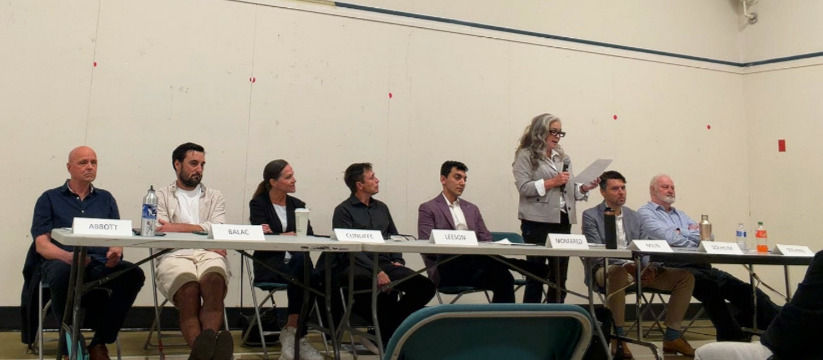
During the discussion that followed, Councillor Neville Abbott noted that while residents of Lions Bay were grateful for Metro's help during the Battani Creek disaster, he is concerned that during a wider-spread event the Village might be forced to stand on its own. He asked which system would best benefit Lions Bay.
Arnold-Smith said the formal structure of a multi-jurisdictional system would probably allow for the most support in the future, however Mitchell said that commitment is the key.
"We live in changing times and I don't think we should ever be content with old models or even the current model. You need to keep asking questions and ensure that you continue to be engaged, and at the table and participating in all the discussions."
The full Emergency Management presentation can be seen in the first 30 minutes of Tuesday's COW meeting HERE.
The Watershed welcomes your thoughts.
Leave your comments below,
or email us at editor@lionsbaywatershed.ca
Like what you're reading?
For as little as $5/month, you can support local independent journalism
by subscribing to The Watershed HERE.


Comments