


Go, Go, Go!

Local residents review Evacuation Plan

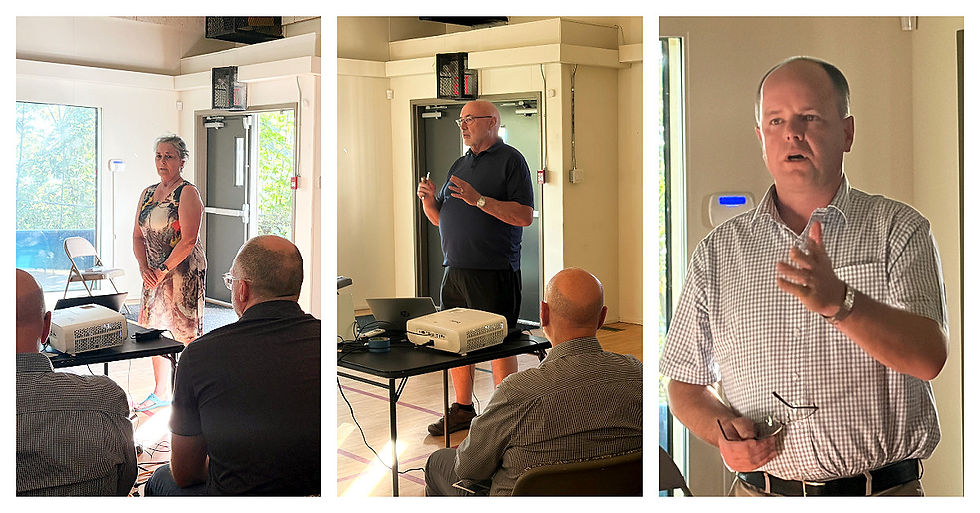
Dozens of Lions Bay residents recently gathered to learn about the new Community Evacuation Plan.
Emergency Program Coordinator (EPC) Mary Brown began the meeting by clarifying her role, noting that the EPC is charge of coordinating emergency response in the Village. In her former role as head of Emergency Social Services, (ESS) she would help find short-term support for people who found themselves without insurance or similar coverage during an emergency. Long-term Lions Bay resident Roel Coert now heads the Village ESS program.
Brown said that she and fellow resident Leslie Nolin successfully wrote a grant to cover the costs of hiring an experienced firm to develop the plan. Calgary firm AB Consulting won the bid, and were represented for the evening by consultant Chris Jancowski.
The new 2026 Emergency Evacuation Plan is now available on the Village website HERE.
Jancowski said that a good emergency plan has to consider a number of hazards, including wildfires, landslides, severe weather, coastal hazards and earthquakes.
He echoed Brown's introductory comment about the importance of clear, accurate communication, and encouraged all residents to add the Alertable app to their phones.
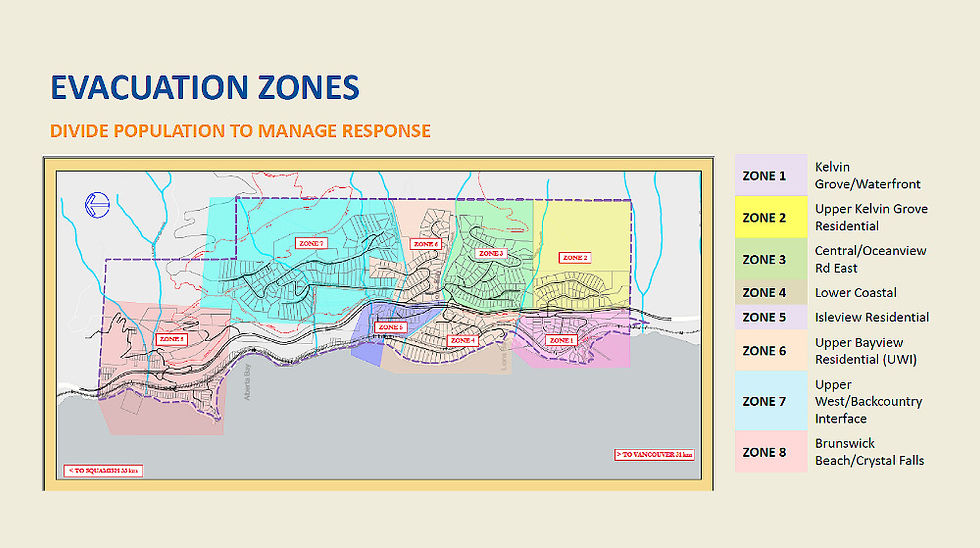
Jancowski noted the new Evacuation Zone map (below) divides the Village into eight zones. In the case of a limited event in one area, residents can be informed by zone whether they need evacuate, shelter in place or take no action at all. The zone system also allows for a staggered evacuation in the case of a Village-wide emergency, allowing roads to stay open and residents to be directed to safety. The map can be found as a part of the new Evacuation Guide, HERE.
Jancowski clarified the difference between an Evacuation Alert, which requires residents to be ready to depart on short notice, and an Evacuation Order, which requires residents to leave their homes within a few minutes. He emphasized the importance of personal responsibility in this process, and asked how many residents were prepared with a 'Grab and Go' bag in their home, another in their car, and a third at their place of work.
He added that the bags should each contain support to ensure at least 72 hours of independence for each family.
The plan offers a multi-modal evacuation strategy, with road, marine and air options, depending on the situation.
Brown said that Lions Bay's ESS Director Roel Coert is currently putting the finishing touches on the Village's first-ever Marine Evacuation Plan. Coert provided a brief summary, noting that the plan involves using a barge which can pull right up to the beach. Along with the additional use of local boats and water taxis, the barge can be used to evacuate residents during a critical emergency when road access is blocked.
Jancowski strongly recommended that families do a weekend preparedness test, practicing sheltering in place for 72 hours, and seeing if they can cope if the power and are water turned off. He noted that such tests can illustrate what essential items to keep near at hand, including barbecues and camping stoves to cook on. He also said that the household water tank has a valve at the bottom and is a good source of clean drinking water in case of an emergency.
"Understand your zone, know what the alert levels mean, and make a list of the five things you'd take from your home if forced to evacuate on short notice," he said. "Knowing these things in advance, and planning for them, helps you to be more personally prepared for an emergency."
Earlier in the evening, Director of Alberni-Clayoquot Regional District (ACRD) Bob Beckett gave a presentation addressing lessons learned after the Mount Underwood wildfire which cut off the community of Bamfield for weeks in 2025.
The wildfire began on August 11, quickly burning across and blocking the main road leading to the tiny community south of Ucluelet on the west coast of Vancouver Island. The nearby Hu-aay-aht First Nation village of Anacla was also cut off. The main road to these communities was closed to public use until October 24, and the fire itself was not declared out until December 8, after burning 3,518 hectares of the local forest.
While Beckett lauded the hard work of the staff and volunteers who supported the community's Emergency Operations Centre (EOC), he said the event showed areas where big gaps existed in the community's preparedness.
Almost immediately after the fire started, power lines went down and the internet was unavailable. There was no generator in the school, or the local gas station, and residents were unable to access propane, as its pump required power.
In terms of lessons that can be applied in Lions Bay, Beckett stressed the importance of ensuring generators are available in essential community buildings, appointing a local resident who understands Village needs to communicate with EOC officials and to designate a location where residents can go for regular information updates.
He also emphasized the importance of building relationships with neighbouring communities and First Nations, noting that pre-existing relationships improve collaboration and response times in times of crisis.
Brown closed the evening with a reminder to residents that she is spearheading an "In It Together" program. She pointed to the residents of Mountain, Sunset and Timbertop who are in the process of forming "pods" of 15-20 neighbouring families, in order to work together to gather and share information. The groups are connecting via WhatsApp, opening another route for communication during emergencies.
"It's not a nosy-neighbour thing," Brown said. "It's a way that we can help each other through communication. Knowing who lives in the house next door is important. Do they have pets that need rescue? Do they have kids needing help? Remembering that we are in it together when an emergency happens means we are more prepared."
Brown also noted that pods can gather information on resources held by immediate neighbours, adding that knowing who has a generator or a stash of plywood can be important during a crisis. She said it is her goal to have every home in the Village connected in this way.
After the presentation, discussion arose on the viability of alternative escape routes. While the idea of accessing trails through the woods or down along waterways was suggested, Brown said that Emergency Services personnel consider those routes to be the lowest priority.
With regard to concerns such as the locked gate at Soundview Trail, Lions Bay Fire Rescue (LBFR) member Theresa Medina reminded residents that the fire crew trains every week to be able to use the tools required to help get people to safety in emergency situations.
The next meeting to organize neighbours into pods will take place in mid-July for residents who live at the top of Oceanview Road. Brown asked residents of other areas around the Village to reach out to her at mbrown@lionsbay.ca about forming their own neighbourhood pods.
The Watershed welcomes your thoughts.
Leave your comments below,
or email us at editor@lionsbaywatershed.ca
Like what you're reading?
For as little as $5/month, you can support local independent journalism
by subscribing to The Watershed HERE.



Nice work Mary and Leslie!!! How lucky are we to have these two!!